

 Apple Podcasts

 Spotify

 RSS Feed

 Amazon Music

 Audible

 iHeartRadio

 YouTube

 Podcast Addict

 PlayerFM

 Deezer

 Pandora

 TuneIn

 Podchaser
She Was 17. She Was Missing. They Called Her A Runaway And Kept It Moving.
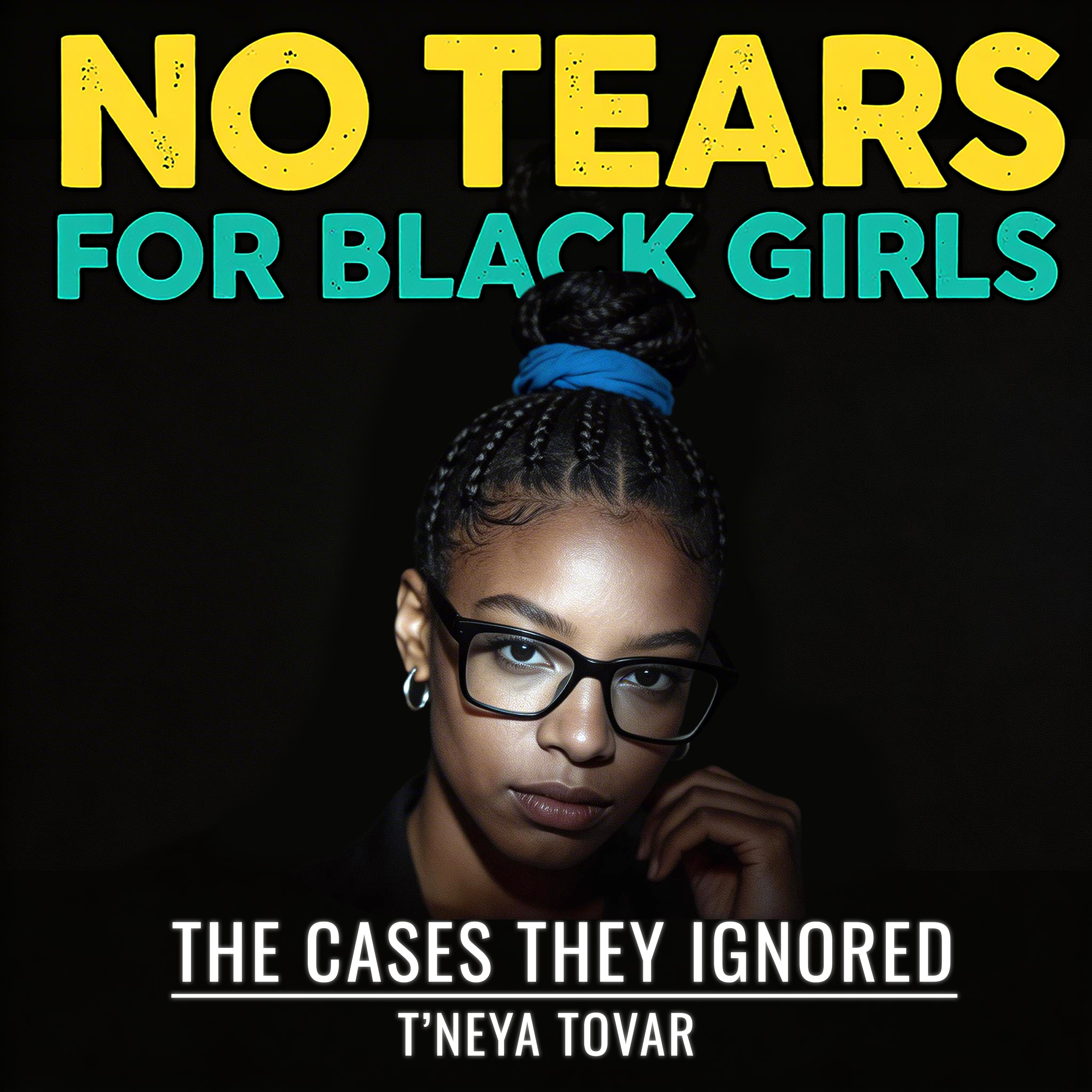
On December 1st, 2025, seventeen-year-old T'Neya Tovar left and never came home. Her mother knew immediately something was wrong. Law enforcement had a different word for it. Runaway. And that one word changed everything about how fast the world moved for her daughter.
In this episode of No Tears For Black Girls, we go deep into the disappearance and death of T'Neya "TT" Tovar, a teenager from Hemet, California whose case exposes one of the most dangerous blind spots in the American missing persons system. What happens when a young Black girl in foster care goes missing and the system decides her history is more important than her safety? What happens when a mother drives seventy miles to a gate that never opens, begs for a search warrant, and gets told to wait? What happens when the internet starts talking before investigators start moving?
We trace the full timeline from December 1st through the arrest of fifty-one-year-old Abraham Feinbloom, the court proceedings that followed, and the questions that still have no answers. We separate the proven facts from the public speculation, the neighbor accounts from the internet rumors, and we do not sensationalize what does not need to be sensationalized because T'Neya's story is heavy enough on its own.
This is not just a missing persons case. This is a story about what the runaway label costs. About who gets treated like an emergency and who gets treated like a pattern. About the gap between a family's fear and a system's urgency. About what Black women and girls are up against before danger even finds them.
No Tears For Black Girls is Black true crime told with care, with truth, and without apology. We cover Black women stories that the mainstream news cycle picks up too late, covers too briefly, and moves on from too quickly. We stay.
SHOW NOTES:
Episode: The Cases They Ignored — T'Neya Tovar
T'Neya "TT" Tovar. Born October 6th, 2008. Reported missing December 1st, 2025 from Hemet, California in Riverside County. NCMEC Case Number 2072404.
NCIC Number M728779732.
On December 21st, 2025, partial human remains were discovered in the Vista Del Mar area near Salton City in Imperial County, near Portsmouth Avenue and Newhaven Court. DNA testing confirmed in February 2026 that the remains belonged to T'Neya.
On February 13th, 2026, Abraham Feinbloom, age 51, of Salton City, California was arrested on suspicion of murder and resisting a peace officer. He has been charged with one count of murder under California Penal Code 187a with a firearm enhancement. He has pleaded not guilty and remains in custody without bail. The case is ongoing.
If you have information related to this case, contact the FBI tip line at 1-800-CALL-FBI or submit a tip at tips.fbi.gov. A ten-thousand-dollar reward has been offered for information leading to a resolution of the case. You can also contact the National Center for Missing and Exploited Children at 1-800-THE-LOST.
If this episode brought up anything heavy for you, please reach out to the Crisis Text Line by texting HOME to 741741. You are not alone.
New episodes of No Tears For Black Girls drop every Tuesday. Subscribe wherever you listen to podcasts so you never miss a case. Leave us a five-star review if this episode moved you. Share this episode with someone who needs to hear it. The more people who listen, the more cases we can cover, and the more families we can make sure are never forgotten.
Follow us on social media for case updates, behind-the-scenes content, and community conversation.
Find us everywhere under No Tears For Black Girls.
CREDITS:
Created, Written, & Produced by John Reedburg
Hosted & Narrated by Samantha Paul
Production Company: John Reedburg Media
SOCIAL MEDIA LINKS:
https://www.youtube.com/@NoTearsForBlacksGirls
facebook.com/notearsforblackgirls
instagram.com/notearsforblackgirls
tiktok.com/@notearsforblackgirls
0:01 Imagine this. You are 17, and you've learned the hard way that adulthood has a shortcut word for kids like you. Run away. Not a daughter, not a child in danger, not a teenager whose brain is still forming, whose trust is still being shaped, whose idea of safety can be rewritten by the wrong adult in the right moment. Just run away. A word that sounds like a choice. A word that quietly gives everyone permission to wait. Imagine the way waiting feels when you're the one who's vulnerable. Imagine the sun going down in a place that isn't yours. A place where streets don't have memories of you, where your name doesn't mean anything to the neighbors, where your face isn't familiar enough for someone to say, hey, you don't belong out here with him.
0:55 Imagine how fast a bad situation can tighten when you're far from home and the only proof you exist in that moment is a phone in your hand. Now imagine that phone goes quiet. Not the normal quiet of a teenager ignoring a call. The wrong kind of quiet. The kind that makes your skin prickle before your mind can explain it. The kind that turns a mother's worry into something sharper, something that doesn't go away when she tries to talk herself down, something that doesn't let her sleep. This is no tears for black girls. I'm Samantha Paul. This story involves the disappearance and death of a teenager and the recovery of partial human remains.
1:38 Please take care of yourself while you listen. And one more thing, because we live in an age where rumors travel faster than rescue, in this episode, I'm going to keep a clear line between what has been publicly reported as fact, what people said publicly as witnesses or family members or attorneys, and what the Internet tried to turn into certainty without proof. We're not here to build a myth. We're here to honor a life with the truth we actually have. Her name was Tanaya Tovar. People called her TT. She was 17 years old. The people who loved her described her as bright, creative, full of personality.
2:19 The kind of teenager who could fill up a room without even trying. A teenager still figuring herself out, still testing limits, still learning what freedom really costs. Public reporting also described her as a youth involved in systems that too often become labels instead of life lines. Foster care. Juvenile probation. Prior runaway reports the kinds of details that can be used to explain someone away instead of to protect them. Because the way a system sees you decides how urgently it moves for you. Tenea was reported missing on December 1st, 2025. Her family said that was the day communication stopped.
3:00 That was the day the normal things that kept her tethered to people who cared about her suddenly didn't work anymore. Calls went unanswered. Messages didn't get replies. Location sharing stopped. That is what her family felt first, before they knew anything else. Silence. The specific silence. That doesn't feel like attitude. That feels like a door shutting somewhere you can't reach. In the early public descriptions of the case, she was connected to the thermal in Salton City area in Southern California, out near the Salton Sea. A landscape that can look open from far away but still hold secrets close. A place where distance can become an accomplice because distance buys time for whoever wants time. As the days unfolded, public reporting described a location that became the center of the family's fear, a home on Harlequin Court in Salton City.
4:00 The family said they learned Tanaya had planned to meet an adult man there, someone they didn't know. That man was identified publicly as Abraham Fineblum, a Salton City resident, 51 years old at the time of his arrest. When a missing teen is linked to an adult man, the public mind goes to the same place quickly. How did they meet? How long did they know each other? Who else knew? Who else failed to stop it? Those questions aren't gossip, they're instinct. They're people trying to find the first domino, the moment where this could have been interrupted. Public reporting later stated that investigators believe Tenea and Finebloom had been in contact since at least October 2025. Friends of Tenea told reporters they had witnessed an encounter between the two at a transit station months before she disappeared.
4:53 That detail matters because it suggests this did not begin on December 1st. It suggests a lead up, a slow build, a runway. Toward the moment the phone went quiet. Her parents did not wait at home and hope they drove over and over. Public reporting described Charo Tovar and Josh Carter traveling out to that Harlequin court address, repeatedly requesting welfare checks, pleading for someone to search the property. They described never seeing Finebloom come outside, just a gate that wouldn't open and a wall that didn't answer, and the feeling that every day the system treated as ordinary was a day their daughter could not afford to lose.
5:35 This is what families of missing teens know too well. The way you can feel the danger in your body, but you can't translate it into the exact legal language that forces a door open. The way you can have a name, an address, a fear and still be told to wait. The way a teen's history becomes a filter that makes people slow down when they should be speeding up. Because runaway is not a neutral word in practice, it is a posture. It is a story the system tells itself to justify why urgency isn't necessary yet. But danger doesn't wait for the paperwork to catch up. As the search continued, the public pressure rose. Her mother posted about the disappearance and asked people to share her photo. The community's attention grew.
6:22 And as always happens in cases like this, social media became two different worlds at once. In one world, people were trying to help, sharing information, calling in tips, amplifying a mother's plea. In the other world, people were treating it like content, like a mystery built for their entertainment. When official information is limited, rumor walks in and sits down like it belongs there. People online began to speculate about grooming. They talked about trafficking because missing teen and older man is a combination that triggers a very real and very justified fear. People suggested other victims, other incidents, other girls connected to that same house.
7:08 Some of those statements echoed things neighbors would later say publicly to reporters. Some of them were Internet smoke, the kind that spreads because it feels familiar, because it matches other tragedies people have watched from a safe distance. The hardest part is that smoke doesn't just cloud the truth. It can make witnesses retreat. It can create false confidence where the public thinks they already understand what happened and stops paying close attention to what is actually being proven. It turns a missing girl into a narrative before she's even been found. On December 21st, 2025, deputies responded to a report of human remains in the Vista Del Mar area near Salton City, near Portsmouth Ave. and New Haven Court. What was recovered was described publicly as a human leg showing signs of decomposition.
8:02 At that time, investigators could not determine identifying characteristics from the remains. The remains were collected, examined, and agencies work to develop ADNA profile. If you have never been close to a missing person case, you might not understand what that kind of information does to a family. It doesn't land as a clean answer. It lands as a door cracked open just enough for your mind to run somewhere terrible. It lands as hope and dread at the same time. You can be a mother still praying her child is alive while hearing that a part of a human body was found near where her child was last connected to someone she'd never met.
8:44 And you still have to wake up the next morning. You still have to make phone calls. You still have to push. You still have to live inside the space between what you fear and what you can prove. Public reporting described Charo Tovar repeatedly trying to get answers, questioning why confirmation took so long, describing being given early impressions that did not match the truth that later emerged. Whether those impressions came from incomplete information or miscommunication, the impact is the same for a parent. Time passed. The family stayed in a limbo that no one should have to survive. Weeks went by.
9:26 The holidays arrived. The kind of season that is loud for everyone else, lights and music and gatherings. And for a mother with a missing child, that noise can feel like the world moving on without her permission. During that time, neighbors began to speak publicly about the Harlequin Court property. They described it as boarded up, isolated, a place that felt wrong in a way that was hard to name but impossible to ignore. Some neighbors described hearing unsettling sounds at night. Some described bright lights. Some described screams. These are public neighbor accounts, not evidence proven in court.
10:06 But they are part of what shaped community fear. And they are part of what made the family's sense of desperation feel grounded. Because it wasn't just them. The neighborhood had been watching. The neighborhood had been afraid. Public reporting also noted that neighbors described noticing security cameras being installed around the property during the investigation. That detail lodged in the public mind like a splinter. Because if you are a parent driving 70 miles at a time to beg for a search, and you hear that the person inside that gate is reinforcing the walls while your child is missing, the story stops feeling like a mystery and starts feeling like a countdown you've already lost.
10:52 On February 6th, 2026, investigators received a positive female DNA match connected to the remains and contacted Charo Tovar for a comparison sample. Public reporting stated that rapid testing confirmed the remains belong to Tenaya. That is the moment the case changed shape entirely. Because now it wasn't an unnamed limb in evidence storage. Now it was TT. Now it was the girl whose face had been shared thousands of times online. Now it was the daughter Charo had been driving toward that pink walled house to find. Also on February 6th, public reporting stated that authorities executed a search warrant at the Harlequin Court property. A search warrant is not a welfare check. It is a legal declaration that investigators believe evidence exists that the threshold has been crossed, that waiting is no longer the official posture.
11:53 The public confirmation followed on February 12th. Authorities confirmed the identification and then on February 13th, 2026, a SWAT team returned to that house on Harlequin Court. Public reporting stated that Finebloom attempted to flee by jumping a fence and was taken into custody. He was arrested and booked on suspicion of murder and resisting a peace officer. He was held without bail. The case entered the court system in full. Finebloom was formally charged with murder and a firearm enhancement. He pleaded not guilty. In public reporting of court proceedings, investigators belief was stated that Tenea died from a gunshot wound and that bullet fragments were recovered from the leg found in that field.
12:41 That detail does not offer closure. It removes the last refuge of uncertainty. It is the kind of fact that makes grief collapse from hoping into knowing, even when the family had already been bracing for it. Public reporting also stated that when Finebloom was detained, he had a passport and foreign currency on his person. Online. Details like that don't sit still. They start screaming. But in a courtroom, a detail is only as loud as what it can be proven to mean. And suspicion, no matter how loud, is not a verdict. This is the tension families are forced to live inside.
13:21 The public wants resolution. The legal process moves on its own timeline. Hearings, discovery motions, challenges to warrants, challenges to how evidence was obtained. Defense side statements made publicly emphasize the presumption of innocence and the argument that the case should be resolved in court and not in headlines. That is how the adversarial system is designed to work, but it doesn't change what it feels like on the other side of it because families aren't living in legal language, they are living in absence. And in this case, public reporting stated that only part of Tenaya's remains had been recovered as these early proceedings unfolded. That is a wound that doesn't seal. It keeps a family in a search state even after an arrest has been made.
14:15 It keeps the story unfinished in the deepest possible way. Now let's speak honestly about the three things the public was most focused on online, because each one tells us something real, even when the specifics aren't proven. The first was the label. People were angry about the idea that a teenager could be filed under runaway and that this filing could slow the urgency of a search. They asked whether the response would have looked different for a different kind of teenager. They questioned whether foster youth and system involved teens are treated as less urgent, less protected, less believed. That anger is not misplaced.
14:57 It is rooted in a pattern that advocates and researchers have documented for years. The second was the contact history and the age gap. Online conversation leaned heavily into grooming language because it is a known pattern in teen victimization. People asked how this relationship began. What was offered, what was used to build trust with a teenager who was already navigating A fractured support system. Public reporting confirmed they were in contact before the disappearance. How that contact developed is something the courts will need to establish with evidence. The third was the question of other victims. The prior dismissed case in public records and neighbor accounts about the property fed that speculation heavily. Some people interpreted a prior dismissal as a system failure. Others argued dismissal means exactly what it says legally, which is that the charges were not proven. Both reactions reveal the same underlying truth. People do not trust that systems consistently protect girls, and that distrust is not paranoia.
16:04 It is pattern recognition. It is memory. But here is the thing about pattern recognition. When it runs ahead of evidence, it can turn a victim into a placeholder for every injustice instead of a person in her own right. Tenaya's story doesn't need to borrow weight from other cases. It carries its own. So hold what is confirmed. December 1st, the silence. December 21st A discovery in a field near where she was last known to be. February 6th, the DNA match. February 12th, the public confirmation. February 13th, the arrest. Now hold what those dates feel like in a mother's body. The 70 mile drive to a gate that never opened. The welfare checks that knocked and left the weeks between a limb in the ground and a name on a report. The phone calls to the coroner trying to understand if what was found could be her daughter.
17:01 The Christmas that passed in the middle of a search. The new year that arrived without resolution. The way February 6th must have felt like the world splitting open. Both the confirmation of a match and the execution of a warrant on the same day, As if everything that should have happened earlier had finally, too late, found its footing. This is where the systems critique lives. Not as a footnote, not as a policy statement, as the thing that the timeline itself is telling you. When a teen is in foster care, too many people treat their absence as administrative rather than urgent. When a teen has a history of running, too many people decide the next disappearance is more of the same. When a teen is labeled difficult, too many people believe difficulty cancels out victimhood. But a complicated history does not protect a child from violence.
17:57 A probation status does not reduce the obligation to search. And a teenager who has run before can still be running toward danger, not away from home. The response to a missing child should not be calibrated to how perfect the victim appears on paper. It should be calibrated to the fact that a human being is missing. That is the only number that should matter, because predators do not target the most protected kids. They target the kids the world is already used to overlooking. They look for the ones the system has already categorized, the ones whose disappearances will be explained before they are investigated, the ones whose mothers will be made to feel like they are overreacting right up until they aren't. Tanea Tavar was 17.
18:43 She was a daughter. She was TT the girl with energy through the roof, the creative spirit, the force her uncle described as giving even him a run for his money. She was not a file. She was not a pattern. She was not a lesson that should have cost this much to learn. As this case continues through the courts, hold the line between what is confirmed and what is claimed. Let the legal process do what it was designed to do, while holding the family in the kind of attention that doesn't expire after the arrest. Because the arrest is not the end of the story. The rest of Tenaya has not been recovered. The family is still waiting.
19:25 The court proceedings are still ahead. And justice, real justice, moves slower than news cycles and cares nothing about how ready we are for it. If you have information about this case, you can contact the FBI at 1800 Call FBI. You can also contact the National Center for Missing and Exploited Children at 1800. The lost. This is no tears for black girls. I'm Samantha Paul. Stay loved, stay safe, and remember, whenever you're trapped in a World of Darkness, never allow fear to overwhelm you. Believe in your inner spirit and remind yourself of God's first words.
20:06 Let there be light.