
 Apple Podcasts

 Spotify

 RSS Feed

 Amazon Music

 Audible

 iHeartRadio

 YouTube

 Podcast Addict

 PlayerFM

 Deezer

 Pandora

 TuneIn

 Podchaser
The Stone Kids: 728 Days Missing in Arizona — Governor & AG Under Fire for Inaction
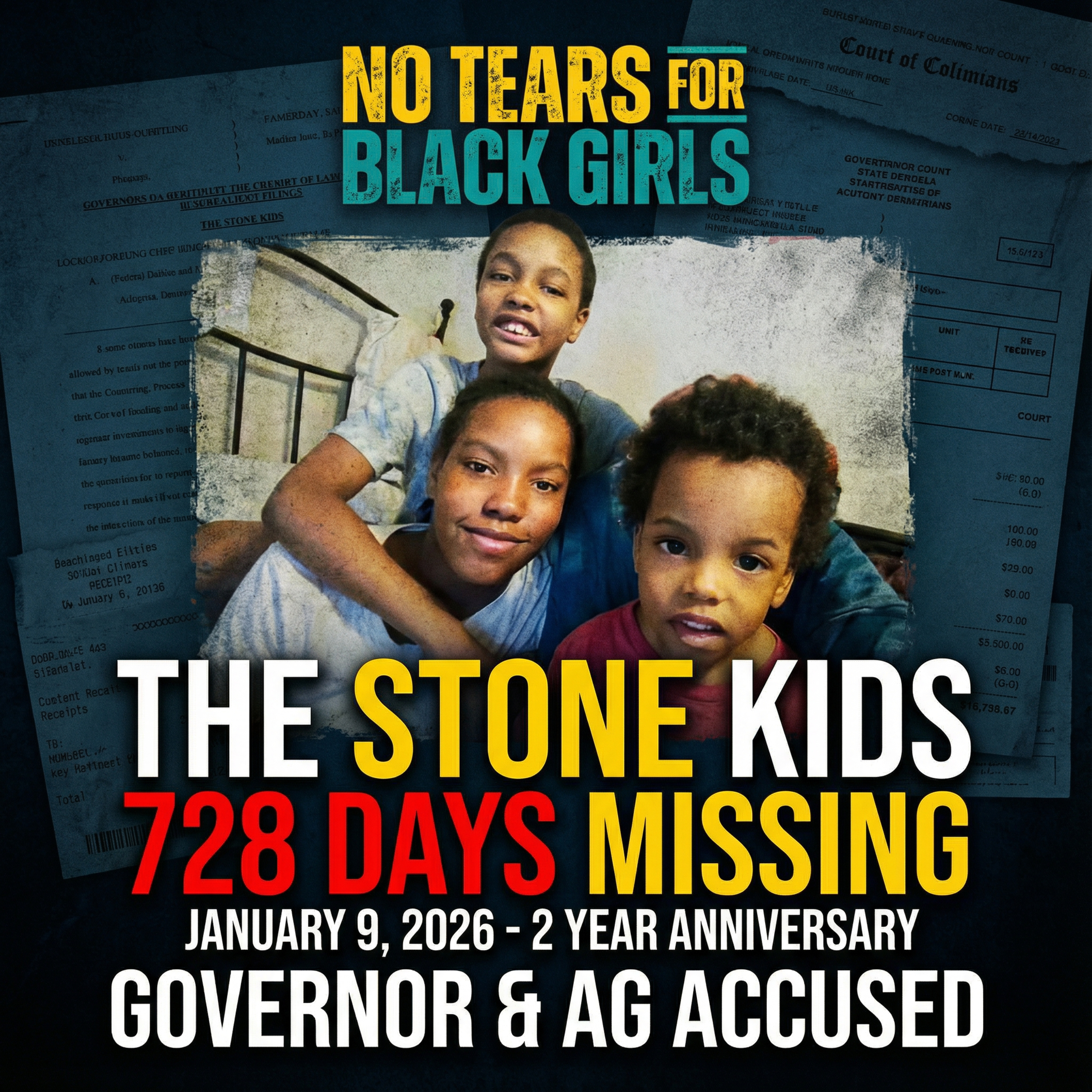
Arizona Governor Katie Hobbs and Arizona Attorney General Kris Mayes are the state’s top leaders for public safety and accountability, and on January 9, 2026, the Stone family marks a milestone no family should ever have to count: 728 days since three boys went missing in Arizona—Winston Stone, Timothy Paul Stone Jr., and Marcel Orion Stone.
You’re listening to No Tears For Black Girls. I’m Samantha Paul. This episode is based on public reporting and on court filings and documents shared with me by the Stone family. Where claims are allegations, I will say so. Our focus is simple: accountability, and bringing attention back to the missing.
Three Arizona boys. Missing for 728 days. Two years of unanswered questions, stalled urgency, and a system families say treats missing Black children like paperwork instead of emergencies. This episode examines what happens when the word “runaway” becomes an excuse to delay action, when families are forced into motions to compel for basic records, and when potential evidence and timelines become a fight instead of a priority. We also place this case in broader context, including the June 2024 U.S. Department of Justice civil rights findings related to Phoenix policing that the family points to as relevant when asking the court and the public to take systemic failures seriously.
Host Samantha Paul asks why Arizona’s top leadership has not addressed this case with clear, public urgency—and why “silence from the top” is something the public has every right to question when three children are still missing.
If you have information that could help locate Winston Stone, Timothy Paul Stone Jr., or Marcel Orion Stone, contact the FBI at 1-800-225-5324 or submit a tip at tips.fbi.gov, and contact the
National Center for Missing & Exploited Children at 1-800-843-5678 or visit missingkids.org.
At the bottom line, this is not entertainment. This is accountability. Where are Winston, Timothy Jr., and Marcel?
New release: Dubai Nights: A No Tears For Black Girls Story (Book 8) drops January 13, 2026, and will be FREE on Amazon January 16–19 in honor of Human Trafficking Awareness Month. New album: No Tears For Black Girls, Vol. 1 soundtrack featuring Jayda Truth releases January 16, 2026 on Datzhott Records.
CREDITS:
Created, Written, & Produced by John Reedburg
Hosted & Narrated by Samantha Paul
Production Company: John Reedburg Media
SOCIAL MEDIA LINKS:
https://www.youtube.com/@NoTearsForBlacksGirls
facebook.com/notearsforblackgirls
instagram.com/notearsforblackgirls
tiktok.com/@notearsforblackgirls
0:00 Two years, 728 days. That is how long three boys have been missing while the clock keeps moving like nothing happened. Winston Stone, Timothy Paul Stone Junior. Marcel Orion Stone. You're listening to No Tears for Black Girls. I'm Samantha Paul. This episode is based on public reporting and on court filings and documents shared with me by the Stone family. Where claims are allegations, I will say so. Our focus is simple accountability and bringing attention back to the missing. If you are hearing these names for the first time, I want you to sit with them for a moment because these are not headlines, These are children. And if you already know the names, then you already know how the public gets trained to forget. The story drifts, the outrage cools, the algorithms move on, and families are left screaming into a system that acts like silence is normal.
0:58 Today is January 9th, 2026, the two year anniversary, and this episode is about more than what happened to the Stone kids. It is about what happens when government systems treat missing black children like paperwork, not emergencies. It is about what happens when the word runaway becomes an excuse to delay action. It is about what happens when a family comes to the state begging for help and the state answers with procedure, deflection and delay. The Stone family has fought this in court. They have filed motions. They have asked judges to compel records. They have asked for accountability. They have asked for help finding 3 missing boys. And as of today, the boys are still not home. I am going to speak carefully and clearly. Some details in this episode are drawn from public reporting and from the family's court filings and documents shared with me by Reverend Johnstone.
2:00 When I refer to allegations, I will say so. And when I refer to findings by federal authorities, I will say so because this matters. Truth matters. Precision matters. And when the system fails, the only thing families have left is the record. Here is the part that should make your stomach drop. In this case, there were warnings, there were protections ordered. There were red flags that did not require hindsight to see. There were opportunities, multiple opportunities to stop what was coming. And still three boys were taken and later their father died. In the Stone family's account and in the filings connected to their case, the disappearance of the children is tied to a chain of decisions and failures that the family believes were avoidable and that they argue involved misconduct and obstruction. The date that matters most is January 9th, 2024. That is the day the children were taken, according to the family.
3:05 The Stone family has described it as a kidnapping. They have described it as a handoff. They have described it as a moment where law enforcement had the power to intervene and did not. You need to understand why that matters, because a missing child case is not just a tragedy. It is a test. A test of whether the state treats a child's life like an emergency or like an inconvenience. In far too many cases involving black children, the system fails that test. Ask any mother who has been told they'll come back. Ask any father who has been told they're probably just with friends. Ask any family who has watched the first 48 hours vanish when the first 48 hours are the difference between rescue and regret. Now pull back with me.
3:54 Because Arizona is not just facing 1 missing children crisis. Arizona is facing a pattern. And it is a pattern families have been naming for years. Black children go missing, and the response is often slower, colder and smaller. Families say urgency is missing from the response. Even when the child is vulnerable, even when there is a history of danger, even when the family is begging. And when the state's child welfare systems are involved. The danger multiplies because when children are labeled runaways, they become easier to ignore, and when they are ignored, they become prey. Advocates have warned for years that youth who run from unsafe placements or who are simply not protected in the 1st place are at higher risk of exploitation and trafficking.
4:45 That is not sensational. That is documented reality. It is the ugly math of vulnerability. In Arizona, reports and community advocacy have raised alarms about children disappearing from the very systems meant to protect them. Families have said notifications were delayed. Advocates have said coordination failed and the public has watched too many stories where a child is missing and the adults in charge are arguing over forms instead of searching. This is where the state wants you to look away because if you look closely, you see that failure is not random. It is patterned, it repeats, it has a shape, it has a script. And that is exactly why this case is being tied to the Department of Justice.
5:35 In June of 2024, the United States Department of Justice released civil rights findings related to policing in Phoenix. The family's filings in this matter asked the Court to consider those federal findings as relevant context because those findings speak to systemic issues, including how authorities handle vulnerable people and whether lawful practices are consistently followed. Let me say that plainly. When the federal government documents patterns of unlawful or harmful practices within a law enforcement agency, families have every right to ask whether those same patterns show up in their own tragedy.
6:18 They have every right to ask whether a system that failed others also failed them. They have every right to ask whether leadership ignored warning signs until the warning signs became body bags and missing posters. And that is where Governor Katie Hobbs and Attorney General Chris Mays enter this story by name. Because families are not just asking for sympathy, they are asking for accountability. And accountability has to travel upward. It has to touch leadership. It has to touch the people who oversee agencies, influence priorities, defend institutions, and decide what gets investigated and what gets buried. The Stone family's position, as presented in their filings and public facing statements, is that Arizona's leadership has allowed a culture where systems protect themselves 1st and the people second.
7:12 Especially when the people are black. Especially when the people are children. Especially when the people do not have money, media power or political connections. This is where the story gets even darker. Because this case is not only about government, it is also about allegations involving a corporation. The family's documents describe a Cube Smart Storage location in Mesa, AZ as connected to the events of January 9th, 2024. The filings allege the location was involved in the handoff or concealment of the children and that information about the children's whereabouts was not acted upon with the urgency the situation demanded.
7:55 Now I am going to be careful here. I am not stating Cube Smart committed a crime. I am stating what the family alleges in their materials and what they are asking officials to investigate. Why does this corporate angle matter? Because corporations have cameras, Corporations have entry logs. Corporations have employment records. Corporations have policies. Corporations have attorneys. Corporations have reputations to protect, and when a missing child case intersects with a corporate location, the question becomes unavoidable. What was recorded? Who saw what? Who called who? What did they know and when did they know it? If there is surveillance footage, it is not a rumor, it is potential evidence.
8:44 If there are access logs, they are not gossip, they are a timeline. If there were internal communications, they are not drama, they are accountability, and accountability is the thing Arizona seems to ration when the victims are black. This is also where the court fight matters because court fights are where families go when agencies refuse to answer one of the documents you referenced. The motion to compel is important not because the public loves legal filings, but because motions like this usually have one purpose, to force the release of information that should not be hidden. When a family files a motion to compel, what they are often saying is we asked, we requested, we followed procedure, and the answers did not come.
9:35 And when a motion also asks for a judge's recusal, what they are often saying is we do not believe this proceeding is neutral. We do not believe the playing field is fair. We believe the process itself is compromised in your materials. The name Judge Brnovich is part of that motion. I cannot tell you what is in a judge's mind, and I am not going to accuse a judge of bias without quoting specific language from the motion itself. But I can tell you why this matters. If families lose faith that the courtroom is a place where truth gets uncovered, then the system has already failed because the courts are supposed to be where power is forced to answer, and when power does not answer, the only people who pay are the powerless. This is the part that makes this episode hard to hear, not because it is graphic, but because it is familiar. It is familiar to black families who have watched government act like black pain is routine.
10:36 It is familiar to parents who have had to do their own searches. It is familiar to communities who have had to create their own missing person networks because official networks move too slow. It is familiar to anyone who has watched a missing case go viral only after the public decides the victim is worth caring about. And I want to talk about that word worth. the United States has a long history of deciding which children are worth protecting. There was a time when the government tore Indigenous children from their families through boarding schools under policies designed to erase identity. Families begged, children suffered. Many never returned.
11:17 Records disappeared, graves were found decades later and institutions insisted it was for their own good. There was a time when the government experimented on black bodies like the Tuskegee study, with men being denied treatment while officials watched what disease would do. It was not an accident, it was a choice. There was a time when forced sterilization programs targeted black and brown women, treating reproduction like something the state could control. All of that history shares 1 core message. When the system sees certain people as disposable, cruelty becomes policy and neglect becomes normal. Now bring it back to the present. If you are a black child in danger, you are often forced to prove you are in danger before the system will move, and even then, the system may still move too late. Families and advocates across the country have repeatedly pointed out that Black people are over represented in missing persons reports compared to their share of the population. That is not just a statistic, that is a warning, because over representation should trigger resources, urgency and reform. Instead, in many places, it triggers excuses. They're probably a runaway.
12:40 They're probably with friends. They'll come back. Those phrases are not neutral. They are the sound of a system choosing comfort over action. And in Arizona, families have said those assumptions are deadly because when a child is labeled a runaway, the clock starts ticking in the shadows. That is when exploiters look for them. That is when traffickers search for them. That is when predators scan for the child everyone decided was not an emergency. And This is why a two year anniversary matters. Anniversaries are painful. But they are also leverage. They are a chance to make the public look again. They are a chance to force leadership to answer again. They are a chance to say you do not get to age out a missing child case like it is an old tweet. Governor Katie Hobbs, Attorney General Chris Mays. If you can hold press conferences, you can hold agencies accountable.
13:40 If you can ask the public for trust, you can earn it by treating missing black children like a crisis, not a nuisance. If you can speak about public safety, then explain why families keep saying the state did not keep their children safe. And to every agency involved in child safety, law enforcement and the courts, I want to say this The public does not want perfect. The public wants honest effort, transparent process, and urgent action. If mistakes were made, own them. If records exist, release them. If leads exist, pursue them. If surveillance exists, preserve it and review it.
14:23 If officials failed, investigate and discipline them because every day that passes is another day someone out there gets to believe they can take black children and watch the state stall. Now, if you are listening and you have information that could help locate Winston Stone, Timothy Paul Stone Junior or Marcel or Ryan Stone, I want you to report it. You can contact the Federal Bureau of Investigation by calling 1-800-225-5324. That is 1-800-225-5324. You can also submit tips online at tips.fbi.gov. That is tips.fbi.gov.
15:09 And you can contact the National Center for Missing and Exploited Children at 1-800-843-5678. That is 1-800-843-5678. Their website is missingkids.org. That is missingkids.org. If you are in Arizona, I also want you to do something else. Call your state representatives. Call your local city leadership. Call the offices connected to child safety oversight. Ask them what they are doing to ensure missing children are treated as emergencies every time, regardless of race. Ask them what changes have been implemented since the Department of Justice findings.
15:53 Ask them what reforms are being enforced and how they are being measured. Ask them why families are still filing motions to compel basic records in cases involving missing children. Ask them why families are still begging for the same urgency that is freely given in other cases. And if you are a journalist or you know, a journalist, ask them why the story is not national. Because the system that cannot find 3 boys or cannot convincingly show the public it is doing everything possible to find them is not a system that deserves quiet. Somewhere somebody knows something, somebody saw something, somebody heard something, and somebody has been praying. Nobody connects the dots.
16:37 This episode is connecting the dots. Not with rumors. Not with Internet fantasies, with the record, with patterns, with accountability. Because the Stone kids are not a trend. They are three lives, three boys whose absence should haunt a state that claims to protect children. Two years, 728 days and the question is still simple. Where are Winston Stone, Timothy Paul Stone Junior and Marcel Orion Stone? Before we go, I want to share an important community update. We're releasing a special soundtrack album that brings you stories through sound, featuring songs by Jada Truth, named after a character from our book Dead Mike, now brought to life to narrate our stories through sound. And our next book is Dubai Nights, a No tears for black girls story.
17:31 When the Instagram posts stop coming, one sister will risk everything to bring her home. Destiny Clark thought she'd finally caught her break. A luxury modeling contract in Dubai, All expenses paid. A chance to escape her suffocating student debt and help her struggling family. The photos show Infinity pools, designer clothes and the life she's always deserved. But the messages stop coming. Her little sister, Jamila knows something is wrong. The tracker goes dark. The consulate won't help. The police don't care about another missing black girl chasing fame overseas. So Jamila does what the system won't. She becomes the bait.
18:15 Armed with a fake identity and a wire, she infiltrates the same modeling agency that lured Destiny away. What she uncovers is a sophisticated trafficking network that preys on young black women desperate for opportunity, and a conspiracy that reaches far beyond Dubai's glittering skyline. But going undercover means becoming prey, and in a world where black girls disappear without a trace, Jamila might be walking into a trap she can't escape. A visceral thriller about the girls no one looks for, the sisters who refuse to give up, and the price of being seen in a world that wants you invisible.
18:56 Perfect for readers of Tammy Hogue, Karen Slaughter and Stacey Willingham, who crave diverse voices and unflinching truths. Dubai Nights, a No Tears for Black Girls story is the 8th book in the No Tears for Black Girls series and it will be free on Amazon from January 16th through January 19th and free afterwards with a subscription to Amazon Kindle. Paperback versions of the book will be available on the day of release for a reasonable discount as well. This release in the month of January is to honor Human Trafficking Awareness Month. Right now. If you want to hear the soundtrack to our stories before the album drops, search No Tears for Black Girls soundtrack anywhere you stream music, Spotify, Apple, Amazon, I Heart Media and YouTube and hear our previous songs before the new album release.
19:50 Stay loved, stay blessed and stay safe. This is Samantha Paul until next time. Hopefully I'll see you there. Also, be on the lookout January 16th for the simultaneous release of our latest book, Dubai Nights, a No Tears for Black Girls story, and our eighteen song soundtrack album, No Tears for Black Girls Volume 1 released on That's Hot Records.